
Agency-led
Often covers only part of the network and moves too slowly to support a real content rhythm.
Restaurant groups do not just need more content. They need a way to make content scale across locations without multiplying coordination overhead at the same pace.
That requires a better operating model for production, consistency, approvals, local activation, and repeatability across the network.

A content model that works for one flagship or one small marketing team rarely scales well across multiple locations. As the network grows, the content challenge becomes more complex:
This is why many restaurant groups feel stuck between too little local output, too much central coordination, and inconsistent execution from external resources.
Often covers only part of the network and moves too slowly to support a real content rhythm.
Quality and consistency vary too much to support brand standards across locations.
Coordination burden grows too fast as the number of locations increases.
Output becomes inconsistent and hard to govern without a clear central system.

A better system for restaurant groups usually includes:
The goal is not just to publish more. The goal is to make the whole system more realistic to run.
This page is especially relevant for:
It is most useful when local feeds are inconsistent, central teams are overloaded, the current model cannot support the whole network, or the brand needs scale without losing control.
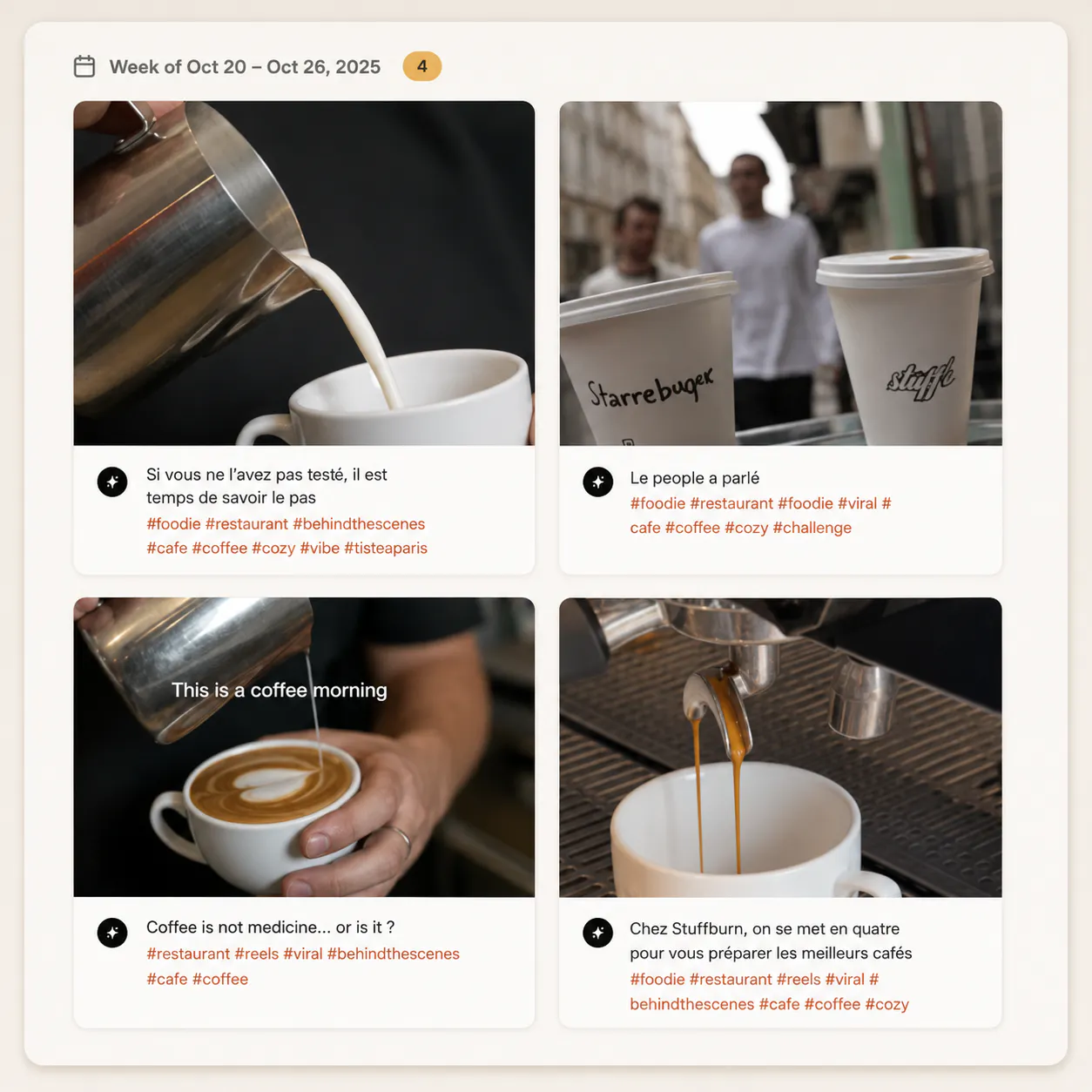
Autopilot is designed for exactly this kind of problem. It is relevant when the team no longer needs just more content, but instead needs:
This is why restaurant content at scale should function as a core Autopilot solution page.
Talk to us about how Autopilot can support content at scale across locations.
Talk to us about Autopilot